previous
index
next
Later Islamic Science
Michael Fowler, UVa Physics
The Islamic World
Our interest here is in the scientific developments that
took place in the Islamic world. We will look at a few of the most famous of
the Islamic scientists, and only mention very briefly the political context in
each case: the spread of Islam over much of the known world, and the subsequent
political changes, were very complex. For example, after Baghdad, Cordoba
in Spain became the preeminent center for science, but Spain
was under the Umayyads, not the Abbasid caliph. Furthermore, some of the
greatest Islamic scientists were Persian, and political developments there
included a Shia revival in the tenth century, the Sunni Abbasids thereby losing
their eastern empire, followed by a Turkish (Sunni) takeover—the Turks having
been brought in as a palace guard.
Omar Khayyam
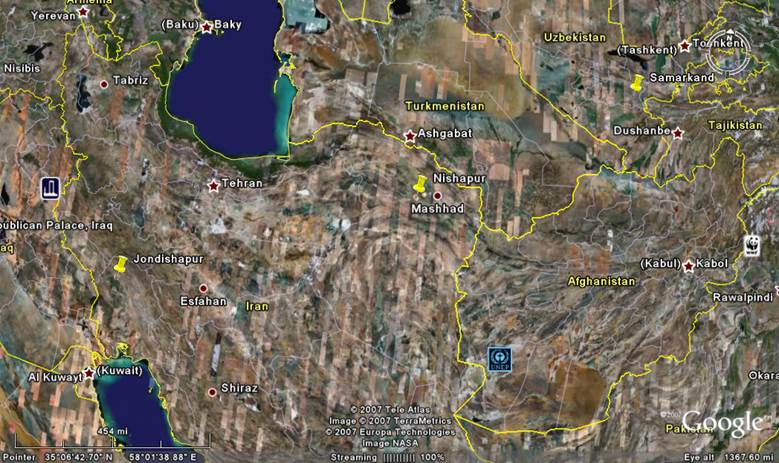
Omar Khayyam was born in Nishapur, in
present-day northeastern Iran (see map) in 1048, a time when most of Persia
(Iran) was under (Seljuk) Turkish rule. Initially, he did not find it a good
environment for scholarly work, and in 1070 moved to Samarkand (see map). He
did manage to write a famous book on Algebra.
His main contribution to that subject is a serious attack on
cubic equations, such as finding x given that 2x3 + 2x2
+ 2x - 1 = 0. This particular problem has a geometric origin:

Given that for the right-angled triangle shown, the sum of
the height and the shortest side is equal to the hypotenuse, find the ratio of
the length of the shortest side to that of the other side.
Later Malik Shah, the third Seljuk sultan, and his Persian
vizier al-Mulk, invited Khayyam to head up his observatory in Esfahan (his
capital city, directly south of Teheran, see map). Khayyam measured the length
of the year, getting 365.242198 days. This is correct to within one second: the
error is in that last digit only!
Unfortunately for Khayyam, his friend the vizier was
murdered by a terrorist group, the Assassins, who specifically targeted
important political figures, on the road to Baghdad in 1092, and Malik-Shah
died soon after that. His widow discontinued the observatory funding, but
later his son Sanjar founded a center in Turkmenistan where Khayyam continued
to do mathematics.
Omak Khayyam is also famous for his writings, such as the Rubaiyat. However, these have a
distinctly irreligious flavor, and he had to tread carefully to minimize
trouble with the Muslim religious authorities.
Al-Tusi
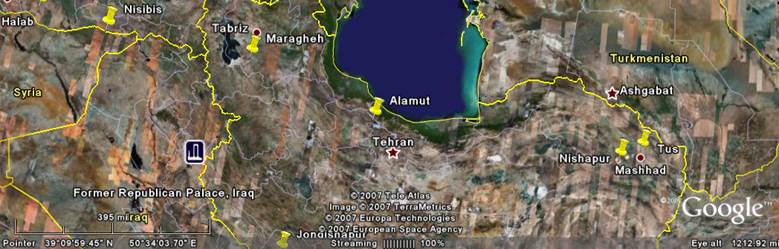
Nasir al-Din al-Tusi was born in Tus, in northwest Iran
(near Nishapur) in 1201.
He studies as a child at a mainly Shia religious school in
Tus, followed by secondary education in Nishapur. However, around 1220, the Mongols
invaded the area, causing much destruction. Al-Tusi found refuge with the
Assassins in their mountain fortress at Alamut :
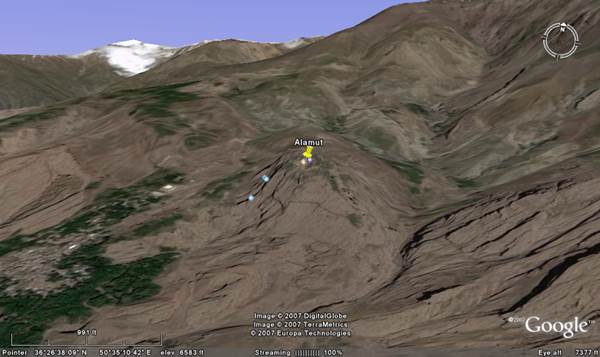
It isn't clear whether or not al-Tusi was actually a
prisoner, but it is clear that he did some important scholarly work in this
relatively quiet environment, writing on astronomy, mathematics, philosophy and
ethics.
Nevertheless, when the Mongols, led by Ghengis Khan's
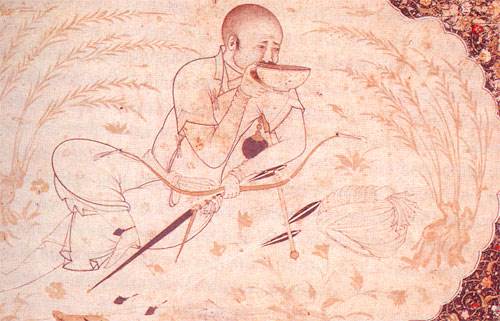
grandson Hulagu (pictured below), took Alamut in 1256, al-Tusi switched sides,
and the Mongols appointed him their scientific advisor.
Al-Tusi was with the Mongols when they attacked Baghdad
in 1258. Apparently if the Caliph (the last of the Abbasids) had surrendered,
little damage would have been done, but instead he refused, told Hulagu that
God would avenge, but the Caliph did little to prepare defenses. The Mongols
attacked (after a brief siege organized by a Chinese general), wrecking the
Grand Library and throwing all the books in the river, burning down mosques and
other buildings that were the work of generations, slaughtering the citizenry
with abandon, breaking up the canal system that had kept the area fertile, and leaving
too few survivors to repair the canals. This was the end of Baghdad as a
cultural center for many centuries. The Mongols went on to fight with Egypt,
but this time they were turned back in what is now the West Bank by superior
Egyptian cavalry, in 1260: the same year that the Hulagu's brother Kublai Khan
became Emperor of China, with his capital at Beijing. The Mongols in the Far
East reached their limit when they attempted to invade Japan
in the 1270's and 80's: their fleet was destroyed by a massive typhoon, one the
Japanese termed kamikaze, meaning divine wind.
After Hulagu destroyed Baghdad, he constructed, at al-Tusi's
suggestion, a magnificent observatory at Marageh in northwest Iran
(see map above) with al-Tusi in charge. The observatory opened in 1262, and
al-Tusi brought together many scholars and scientists. The observatory became,
essentially, a university: al-Tusi had several pupils who made important
contributions, and in fact his role was central in reviving Islamic science.
Al-Tusi himself developed plane and
spherical trigonometry and wrote the first complete book on the subject. He
also made the first really significant advance on Ptolemy's Almagest.
Although Ptolemy's work described the planetary motions well, it contained some
aesthetically unappealing features: it had strayed far from Plato's long ago
suggestion that all should be described in terms of combinations of circular
motions. In particular, accounting for the lack of coplanarity of planetary
orbits required what amounted to an up-and-down linear component in planetary
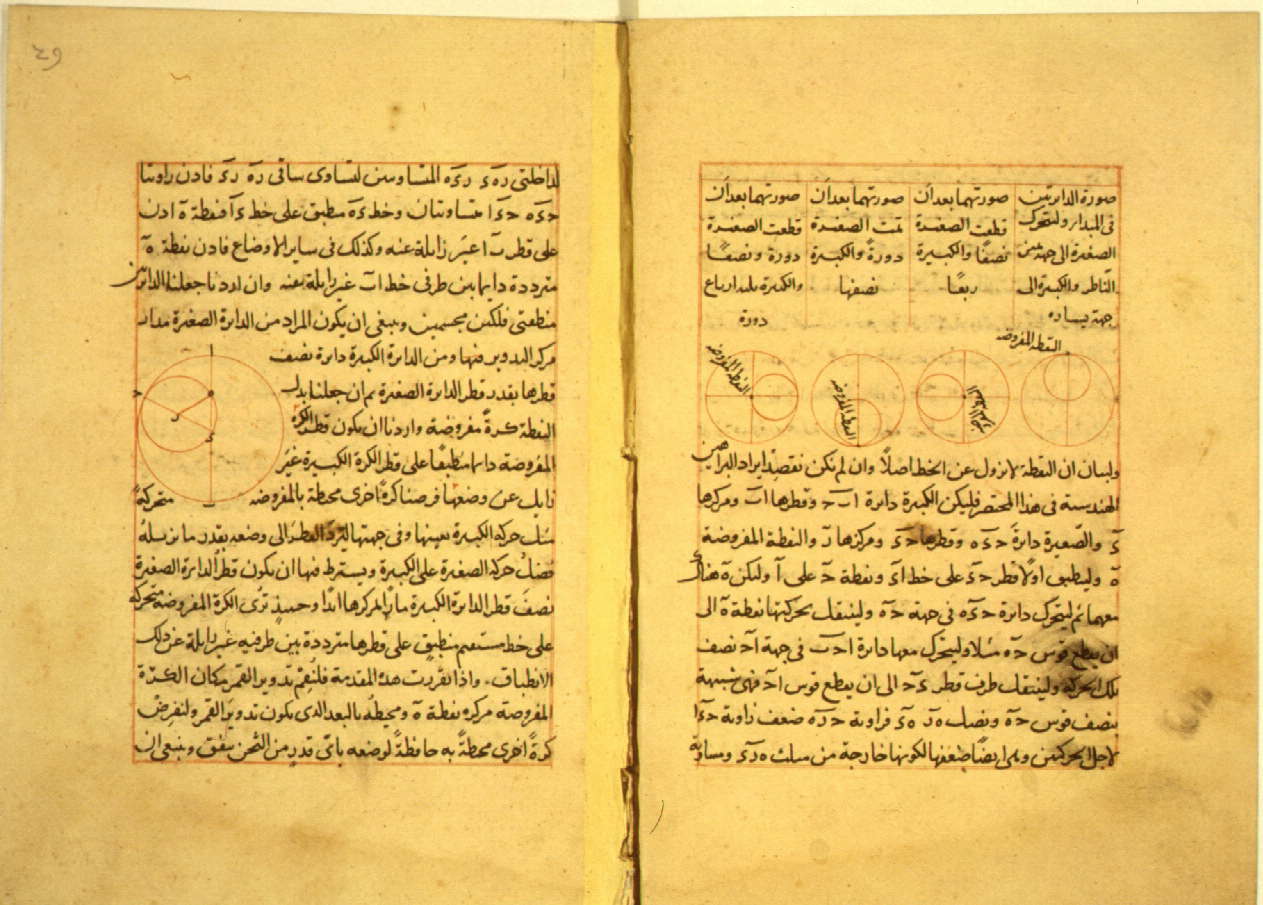
motion. Perhaps al-Tusi's most famous achievement was to demonstrate how such
motion could be generated by a combination of two circular motions, see the
animation at Tusi couple!
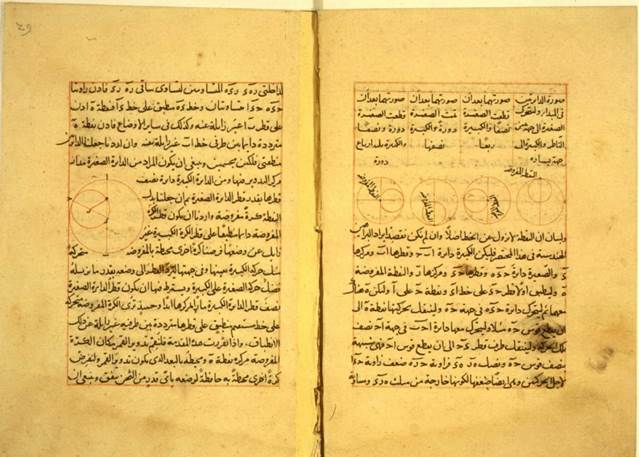
Here's his original explanation, from a Vatican exhibit: